


Hunger for Self Validation On Social Platforms - A Soul Crushing Obsession
- Shrikant Soman

- May 2, 2025
- 5 min read
Hunger for Self Validation On Social Platforms - A Soul Crushing Obsession

With the advent of WhatsApp, Instagram, Facebook, and such other social media platforms during the last decade, a sickness – a relentless hunger for self-validation – has stealthily burrowed into our mindset, often without our conscious awareness. What's worse, this craving is spreading rapidly, engulfing more and more of the population like a viral disease.
This hunger manifests as an insatiable craving for likes, shares, and appreciative comments on our posts.
The absence of external approval can trigger feelings of inadequacy, anxiety, and even a dip in self-esteem.

The perceived worth of an individual, unfortunately, is increasingly being tied to metrics like the number of likes or followers they amass on platforms like Instagram. We meticulously curate our online personas, showcasing only the most flattering angles of our lives, hoping to garner external approval. A new outfit isn't just about personal enjoyment; it's about the potential for a flood of heart emojis. A delicious meal isn't solely for nourishment; it's a photo opportunity, a chance to elicit envious reactions.
We become tethered to the fleeting approval of strangers, our internal compass swaying with the unpredictable winds of social media engagement.
This performative aspect reaches a fever pitch during events like marriage anniversaries. The superficial expressions of deep love and bonding shared by both husband and wife often take an extreme form online. Elaborate declarations, seemingly candid photos brimming with affection, and gushing captions paint a picture of marital bliss that can feel almost fantastical. Consequently, the readers of such posts may feel a pang of sadness or inadequacy, comparing these highly curated snapshots to the realities – and inevitable imperfections – of their own marriage life. This constant exposure to idealized portrayals can amplify feelings of dissatisfaction and longing for a seemingly unattainable level of connection.
Alarmingly, this mental disease of seeking constant validation appears to be taking another concerning form: a heightened intolerance of differing opinions.

However, this craving for self-validation through likes and approving comments has its dark and menacing shadow in the form of trolling. When a person ventures to make public statements, share their thoughts, or even simply exist online, they expose themselves to the potential for merciless trolling. In these brutal online attacks, a person's self-esteem can be cruelly and publicly eviscerated by the mob.
One apparent and deeply concerning effect of this unholy trinity – the craving for self-validation, the intolerance of differing opinions, and the pervasive fear of trolling – is that more and more people have become overly cautious and "socially wise" in expressing their opinions.
The anonymity and perceived distance of the internet embolden some to unleash a torrent of negativity, criticism, and often deeply personal attacks. The very platforms designed to foster connection and validation can become arenas for public humiliation, leaving lasting scars on the victim's sense of self-worth. The vulnerability created by seeking online approval can be brutally exploited, highlighting the precarious nature of relying on external sources for our self-esteem.
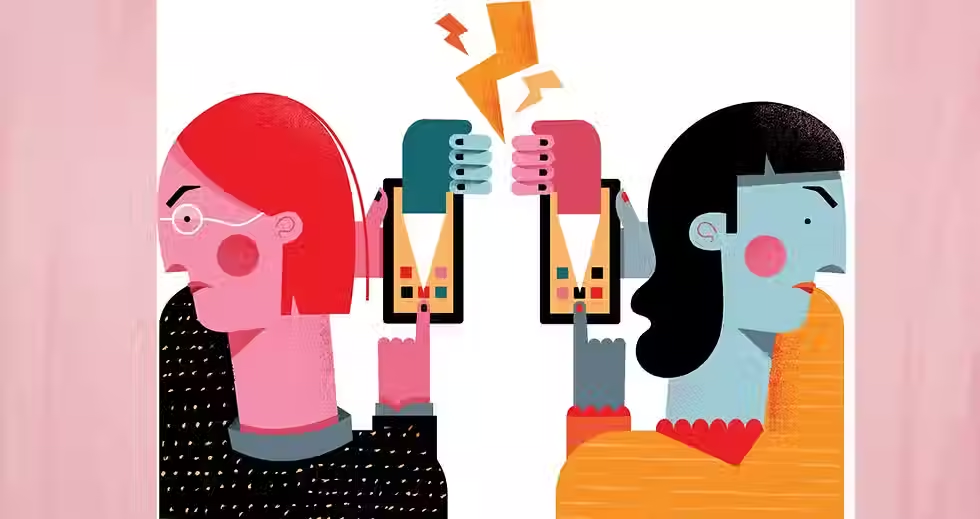
But what happens when the validation doesn't come? What about the posts that receive only a handful of likes? Or the carefully crafted status updates that are met with silence? The absence of external approval can trigger feelings of inadequacy, anxiety, and even a dip in self-esteem. We become tethered to the fleeting approval of strangers, our internal compass swaying with the unpredictable winds of social media engagement.
Ironically, in this tech-driven modern age, where people are ostensibly becoming highly interconnected, surpassing all boundaries of religion, ethnicity, geography, and nations, they are simultaneously growing increasingly separated on an inner, emotional level.

Alarmingly, this mental disease of seeking constant validation appears to be taking another concerning form: a heightened intolerance of differing opinions. This online phenomenon is now worryingly manifesting in the physical world, a direct and detrimental mental migration from social platforms to our everyday interactions.
We scroll through meticulously curated feeds, witnessing a highlight reel of others' seemingly perfect lives, leading to feelings of envy and inadequacy.
We find ourselves increasingly prone to entering a quarrelsome mode the moment someone differs from our viewpoint and 'dares' to express it. Instead of engaging in healthy discussion, we immediately interpret this difference as an 'opposition' – or even worse, as a personal 'attack' driven by 'evil motives.' This toxic dynamic is commonly witnessed in various institutional frameworks, from the seemingly mundane interactions within housing societies to the more structured environments of NGOs and workplaces, further fragmenting our ability to connect and collaborate effectively.

One apparent and deeply concerning effect of this unholy trinity – the craving for self-validation, the intolerance of differing opinions, and the pervasive fear of trolling – is that more and more people have become overly cautious and "socially wise" in expressing their opinions. To avoid the potential for negative repercussions, they either cautiously flow with the prevailing online tide or, increasingly, prefer to remain completely silent.
This growing reluctance for frank and honest self-expression, even when devoid of malice, has rendered our interactions increasingly superficial and devoid of genuine substance. This self-imposed censorship has, in fact, created invisible, inviolable spaces between individuals, fostering a profound sense of inner loneliness even amidst a hyper-connected world.
this reliance on external validation can erode our sense of self-worth. When our value is determined by the fickle nature of online metrics, our internal sense of self becomes fragile and dependent on factors beyond our control.
Ironically, in this tech-driven modern age, where people are ostensibly becoming highly interconnected, surpassing all boundaries of religion, ethnicity, geography, and nations, they are simultaneously growing increasingly separated on an inner, emotional level. Everybody is becoming more of a loner within the ever-expanding mass of their so-called "friends" network.

Secondly, this constant seeking of external validation shifts our focus from intrinsic satisfaction to extrinsic rewards. We begin to do things not because they bring us genuine joy, but because they are likely to be well-received by our online audience. Our authentic selves become filtered, polished, and ultimately, diminished in the pursuit of digital applause.
Thirdly, it fosters a culture of comparison and competition. We scroll through meticulously curated feeds, witnessing a highlight reel of others' seemingly perfect lives, leading to feelings of envy and inadequacy. The pressure to keep up, to project an equally flawless image, becomes exhausting and ultimately unsustainable.
Ultimately, each individual must undertake an honest and frank introspection to find their own unique path out of this insidious trap.
Finally, this reliance on external validation can erode our sense of self-worth. When our value is determined by the fickle nature of online metrics, our internal sense of self becomes fragile and dependent on factors beyond our control. We risk losing touch with our own inherent worth, the value that exists independently of likes and followers.

What then is the solution to this pervasive issue? I have no neat "package" of answers to offer. Ultimately, each individual must undertake an honest and frank introspection to find their own unique path out of this insidious trap. Simply shutting oneself off from social media might offer a temporary reprieve, but it doesn't address the underlying need for validation. Tragically, many choose to stifle their inner selves in order to survive this cruel online jungle, populated by virtual predators, preferring to passively flow with the tide of popular opinion. This, however, is perhaps the WORST possible "solution," because in this slow process of self-preservation, a small but vital part of oneself is silently and steadily eroded, leading to a profound and lasting sense of loss.

For me personally, I have found a solid footing in following the path of mindfulness and practicing Sri Anand Yoga. This practice helps me to remain present and grounded even within the online crowd, while simultaneously creating a sense of inner insulation from the vicious negativity that can nibble away at one's self-esteem. It allows me the fresh air of authentic self-expression without feeling the need to stifle my inner voice for the sake of online survival.


Comments